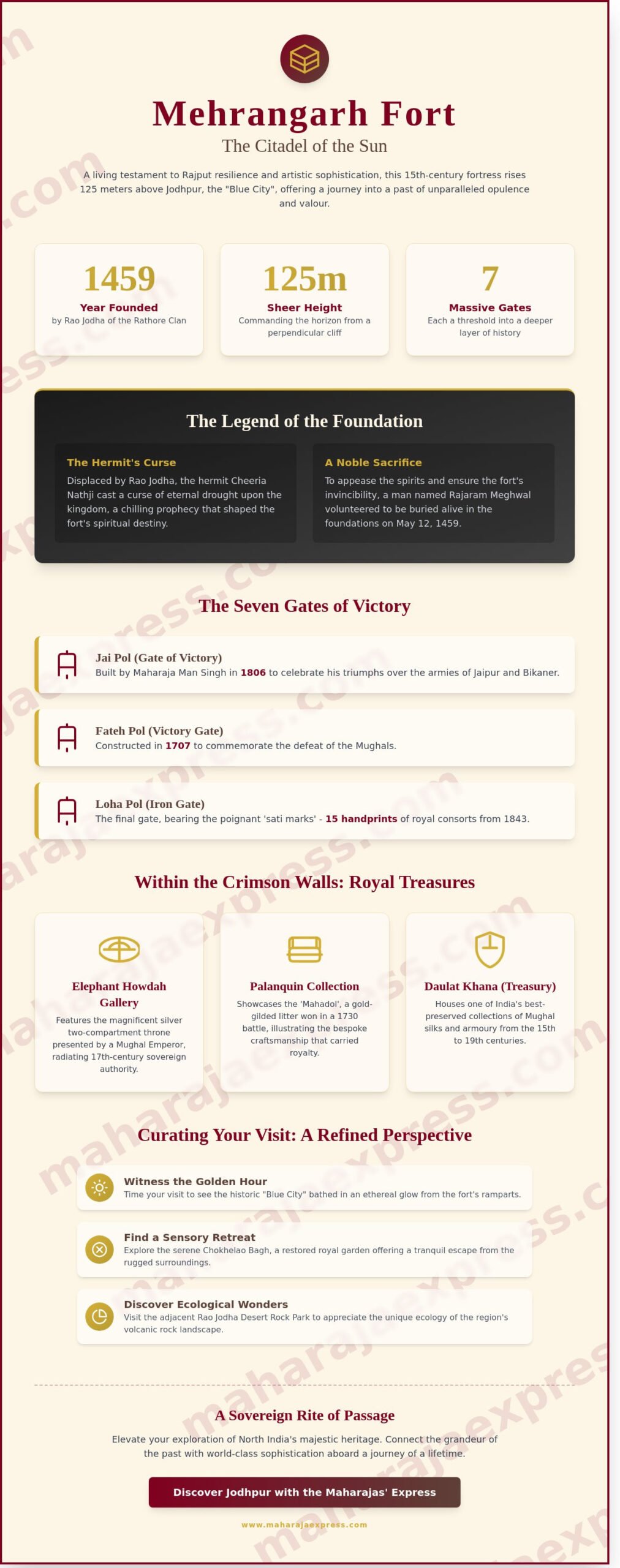
Can a single fortress truly hold the soul of an entire dynasty within its sun-scorched sandstone walls? You’ve likely realized that while North India is adorned with countless citadels, few command the horizon with the absolute authority of the mehrangarh fort jodhpur. Rising 125 meters above the azure city, this 1459 foundation by Rao Jodha represents more than a defensive marvel; it’s a living testament to Rajput resilience and artistic sophistication that continues to captivate the modern traveler.
We promise to guide you through the intricate latticed windows and the private museum treasures that tell a story of unparalleled opulence. You’ll discover how to experience this monumental landmark without the typical fatigue of heritage sites, focusing instead on the refined details of the Sheesh Mahal. This journey serves as an invitation to integrate such historical brilliance into a bespoke itinerary with the Maharajas’ Express. By visiting www.maharajaexpress.com, you’ll see how this sovereign rite of passage connects the grandeur of the past with world-class sophistication. Let’s explore the crowning jewel of Jodhpur’s landscape through a lens of true exclusivity.
Key Takeaways
- Uncover the legendary origins of the “Citadel of the Sun,” exploring how this architectural marvel has stood as a majestic sentinel of Rajput valour since the 15th century.
- Delve into the palatial galleries to behold the silver Elephant Howdah, a masterpiece of craftsmanship that epitomizes the regal heritage and museum treasures of the Maharaja.
- Learn to navigate the mehrangarh fort jodhpur with precision, timing your visit to witness the historic “Blue City” bathed in the ethereal glow of the golden hour.
- Discover the sensory retreat of the Chokhelao Bagh and the ecological wonders of the Desert Rock Park, which offer a refined perspective on the fort’s rugged surroundings.
- Elevate your exploration into a sovereign rite of passage by booking a luxury rail experience through North India at www.maharajaexpress.com.
The Majestic Ascent: An Introduction to Mehrangarh Fort, Jodhpur
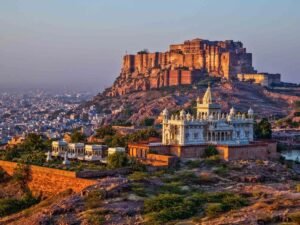
Rising like a titan from the rugged heart of the Thar Desert, the mehrangarh fort jodhpur stands as a sentinel of history, often whispered of as the ‘Citadel of the Sun.’ Founded in 1459 by Rao Jodha, the 15th chief of the Rathore clan, this fortress commands the horizon from a height of 400 feet above the azure skyline of the Blue City. Its burnished red sandstone walls don’t just sit upon the rock; they appear to grow directly from the perpendicular cliffside, creating a seamless union between the earth’s raw power and human ambition. For those embarking on a regal journey with the Maharajas’ Express, the fort represents the pinnacle of Rajput power and an enduring legacy of cultural patronage. It’s a sovereign symbol that has witnessed five centuries of royal evolution, transitioning from a gritty defensive post to a palace of staggering beauty.
The architecture reflects the Rathore dynasty’s dual identity as fierce warriors and refined aesthetes. Every stone tells a story of survival and splendor, ensuring the fort remains one of the most well-preserved heritage sites in North India. It serves as a majestic prelude to the luxury that awaits within the region’s royal corridors.
The Legend of the Fortress Foundations
The site’s history is steeped in the mystical tale of Cheeria Nathji, a hermit who resided on the hill known as Bhakurcheeria, the Mountain of Birds. When Rao Jodha displaced him to construct the citadel, the sage cast a chilling curse of eternal drought upon the kingdom. To safeguard the future of the Rathore line, a man named Rajaram Meghwal volunteered to be buried alive in the foundations on May 12, 1459, a sacrifice intended to appease the spirits. This act of devotion ensured the site’s spiritual dominance and military invincibility. Over the following 500 years, the structure evolved from a stark military stronghold into a palatial residence, blending defensive necessity with the intricate artistry of a royal court.
The Seven Gates of Victory
Entering the mehrangarh fort jodhpur requires traversing seven massive gates, each serving as a threshold into a deeper layer of history. Jai Pol, or the Gate of Victory, was commissioned by Maharaja Man Singh in 1806 to celebrate his military triumphs over the combined forces of Jaipur and Bikaner. As visitors approach the final entrance, Loha Pol, they encounter the poignant ‘sati marks.’ These 15 small, silver-leafed handprints belong to the royal consorts of Maharaja Man Singh, who committed ritual suicide on his funeral pyre in 1843. These gates don’t merely provide security; they stand as silent witnesses to the triumphs and tragedies that shaped the Rajput soul.
- Jai Pol: Built in 1806 to commemorate victory over invading armies.
- Loha Pol: The final gate featuring the historic handprints of royal widows.
- Fateh Pol: Constructed in 1707 to mark the defeat of the Mughals.
Within the Crimson Walls: Exploring Palatial Splendour and Museum Galleries
Stepping beyond the formidable gates of the citadel, guests enter a world where the Mehrangarh Museum Trust preserves the echoes of a regal past with unparalleled precision. Established in 1972 by Maharaja Gaj Singh II, this institution stands as one of India’s most impeccably curated heritage repositories, offering a sensory journey through the Marwar dynasty’s private treasures. The Elephant Howdah gallery serves as a monumental centerpiece, unveiling the silver two-compartment throne presented by the Mughal Emperor to the Maharaja, a piece that radiates the sovereign authority of the 17th century. Nearby, the Palanquin collection showcases the Mahadol, a gold-gilded litter won in battle in 1730, illustrating the bespoke craftsmanship that once carried royalty across the desert sands.
The Daulat Khana, or the Imperial Treasury, houses a collection of Mughal silks and ancient armoury that reveals the intersection of military might and artistic refinement. This gallery contains one of the best-preserved collections of 15th to 19th-century artifacts in the subcontinent. Visitors can observe the transition from raw martial utility to the ornate, jewel-encrusted hilts of later centuries. This curated excellence mirrors the refined atmosphere found during The Indian Splendour sojourn, where every detail is designed to evoke the nostalgia of the princely era.
The Sheesh Mahal and Moti Mahal: Chambers of Light
The Sheesh Mahal, or Hall of Mirrors, creates a shimmering celestial atmosphere where intricate glasswork and religious iconography dance under the flicker of oil lamps. Its walls are a mosaic of devotion and light, designed to reflect the divine presence within the royal quarters. Adjacent to this brilliance is the Moti Mahal, the Pearl Cell, where the walls are finished with a polished lime plaster made from crushed seashells to achieve a soft, lustrous glow. Within these spaces, the delicate ‘jali’ lattice screens remain a testament to the architectural grace of the mehrangarh fort jodhpur, allowing royal ladies to observe the vibrant court life while maintaining the dignity of purdah.
The Turban and Armory Galleries
The Turban Gallery offers a fascinating anthropological study into the diverse styles of Rajasthani headgear, where every fold and color serves as a marker of social status and regional identity. In the Armory, the collection includes rare weaponry such as the personal swords of Mughal emperors Akbar and Shah Jahan, items that highlight the complex political alliances of the Rajput kings. A crowning jewel of the museum is the Shahi Lal Dera, a rare 17th-century Mughal red silk tent. It’s one of the few surviving imperial tents in the world, standing as a magnificent example of the mobile opulence that characterized the Mughal court’s travels across the North Indian landscape.
Architectural Grandeur: A Synthesis of Rajput Valour and Artistic Finesse
To approach the mehrangarh fort jodhpur is to witness a formidable paradox of stone; the exterior presents a sheer, impenetrable cliff of burnished sandstone that rises 122 metres above the surrounding city plains. Within these battle-hardened walls, the aesthetic shifts with breathtaking grace toward a world of delicate refinement. This transition reflects the evolution of the Rathore clan, moving from the defensive necessities of the 15th century to the sophisticated patronage of the arts seen in the 18th and 19th centuries. The Chokhelao Bagh, a meticulously restored 19th-century garden, serves as a fragrant prelude to the palace complex. It offers guests of the Maharajas’ Express a sensory journey through traditional Mehtab Bagh layouts where the scent of night-blooming jasmine evokes the poetic atmosphere of a bygone era.
The architectural narrative is enriched by the seamless integration of Mughal aesthetics, which became prominent during the reign of Maharaja Jaswant Singh in the mid-17th century. This influence is visible in the pointed arches and the floral motifs that softened the rugged Rajput silhouettes. The fort’s facades are a testament to the “Jali” tradition, where stone is transformed into ethereal screens that filter the harsh Thar sunlight into patterns of dancing shadows.
The Phool Mahal: A Symphony of Gold and Colour
The Phool Mahal, or Palace of Flowers, stands as the most exuberant chamber within the mehrangarh fort jodhpur; it was commissioned by Maharaja Abhaya Singh between 1724 and 1749. Its walls are adorned with the Ragamala series of paintings, while the ceiling displays an extraordinary application of gold leaf that required over 80 kilograms of the precious metal to complete. While the architecture remains deeply rooted in Rajput tradition, the late 19th-century additions introduce subtle European elements. You’ll find Victorian-style floral patterns woven into the ceiling’s geometry, marking a period where global influences began to grace the private pleasure halls of Indian royalty.
The Zenana Deodi: The Women’s Courtyard
The Zenana Deodi represents the pinnacle of stone craftsmanship, featuring sandstone screens carved with such precision they resemble fine lace rather than solid rock. These intricate designs allowed the royal ladies to observe the court’s festivities while maintaining the dignified privacy required by social customs of the 1700s. Within these courtyards, the ‘Jhula’ collection remains a poignant highlight. These ceremonial swings, often embellished with silver and ivory, were central to the Teej and Gangaur festivals. They symbolize the romanticism that flourished within the fort’s secluded quarters, ensuring that every corner of this citadel resonates with a storied elegance.
Curating Your Visit: Practical Wisdom for the Discerning Traveller
To witness the ethereal transformation of Jodhpur into the legendary Blue City, you must time your ascent to the ramparts with absolute precision. As the sun begins its descent at approximately 5:30 PM during the temperate months of October through March, the sandstone of mehrangarh fort jodhpur absorbs a liquid gold hue, casting long, dramatic shadows over the azure dwellings below. It’s a sovereign appointment with history that demands a slow, appreciative pace. For those who seek a perspective that balances ancient architecture with modern adrenaline, the Flying Fox zipline offers six distinct circuits. These cables span the battlements, providing a bird’s eye view of the 15th-century masonry and the deep moats that once deterred invaders.
At the southern extremity of the citadel lies the Chamunda Mataji Temple, established in 1460 by Rao Jodha himself. This sacred site remains a pillar of Rathore devotion. The air here often carries the heavy scent of incense and the rhythmic echoes of ancestral prayers, offering a moment of profound spiritual stillness amidst the architectural grandiosity.
The Rao Jodha Desert Rock Park
Adjacent to the fort’s formidable walls lies a 72-hectare ecological marvel, meticulously restored since 2006 to preserve the indigenous lithophytic flora of the Thar. This volcanic landscape features the Malani Igneous Suite, a geological formation dating back 750 million years that has earned the prestigious status of a National Geological Monument. You can traverse curated trails to observe over 250 species of plants that thrive in the rhyolite rock, providing a stark, beautiful contrast to the manicured opulence of the royal quarters.
Sunset at the Pachetia Hill
For the most evocative photographic captures, the Pachetia Hill viewpoint provides an unobstructed vista of the city’s sapphire heart. The evening Aarti at the temple provides a sensory anchor to the day, as the rhythmic tolling of bells signals the transition into a starlit Rajasthan night. Before departing this citadel of dreams, a visit to the museum shop reveals a collection of bespoke heritage souvenirs. These items, from intricate miniature paintings to silk textiles, mirror the same world-class sophistication found aboard the Maharajas’ Express.
A Graceful Sojourn: Discovering Jodhpur Aboard the Maharajas’ Express
To visit the Sun City is to step into a living canvas of history, yet the most refined way to experience this blue-hued jewel is through the lens of the world’s leading luxury train. The Maharajas’ Express experience transforms a simple sightseeing trip into a sovereign rite of passage. Guests find themselves whisked away from the opulent suites of the locomotive directly into the heart of the Marwar kingdom. This transition is seamless, ensuring that the regal atmosphere of the train follows you as you ascend the winding paths toward the mehrangarh fort jodhpur. Every step of the journey is marked by an unwavering sense of exclusivity, where the ancient traditions of Rajasthan meet the pinnacle of modern hospitality.
The Indian Splendour Itinerary
The visit to Jodhpur serves as a pivotal highlight within The Indian Splendour itinerary, a curated 6-night journey that traverses the most storied landscapes of North India. This voyage is designed for those who seek the extraordinary. After exploring the towering ramparts and ornate palaces of the mehrangarh fort jodhpur, guests are often treated to exclusive lunches at royal venues where the flavors of the desert are served with impeccable grace. The true hallmark of this voyage is the ability to retreat to the unparalleled comfort of a Presidential Suite after a day of historical immersion. It’s a sanctuary where world-class sophistication meets the echoes of a bygone era, allowing you to reflect on the day’s discoveries in total privacy.
Beyond the Fort: The Jodhpur Experience
The adventure extends deep into the vibrant pulse of the old city. You’ll board traditional Tuk-Tuks for a spirited ride through the bustling markets, where the scent of hand-ground spices and the flash of indigo textiles create a sensory feast. These excursions provide a vivid cultural contrast to the silent majesty of the fort’s stone walls. As the sun sets over the horizon, the evening unfolds with bespoke cultural performances and festivities that celebrate the enduring spirit of the Rajputana. The Maharajas’ Express ensures every detail is polished to perfection, from the expert guided tours to the evening’s entertainment. To begin your own royal chronicle, we invite you to view the departure dates for the upcoming season at www.maharajaexpress.com.
Stepping Into a Living Legacy of Regal Splendour
The formidable walls of the mehrangarh fort jodhpur stand as a silent witness to five centuries of Rajput history. You’ve journeyed through the Sheesh Mahal’s mirrored brilliance and walked the ramparts where Rao Jodha first laid the foundation in 1459. This citadel isn’t just a monument; it’s a vibrant chronicle of artistic finesse and military grit. Every gallery within its museum, curated with 15th-century artifacts, tells a story of a kingdom that never bowed. To experience such majesty, your mode of travel should be equally storied.
The Maharajas’ Express has earned the title of ‘World’s Leading Luxury Train’ for seven consecutive years, providing a sanctuary of opulence as you traverse the landscapes of North India. With bespoke guided excursions and hospitality that mirrors the grace of the royal courts, every moment becomes a sovereign rite of passage. It’s a rare opportunity to witness India’s heritage through a lens of unparalleled luxury. Embark on a Royal Journey with the Maharajas’ Express and prepare to be treated like the deity of our ancient traditions. Your seat in this grand chronicle of adventure is ready for you.
Frequently Asked Questions
What is the best time to visit Mehrangarh Fort in Jodhpur?
The optimal period for a royal pilgrimage to Mehrangarh Fort Jodhpur is between October and March, when temperatures average a pleasant 25 degrees Celsius. During these six months, the Rajasthan sun loses its fierce intensity, allowing you to traverse the sprawling ramparts in absolute comfort. It’s the perfect season to arrive via the Maharajas’ Express, ensuring your transition from the world’s leading luxury train to the citadel is as graceful as a sovereign rite of passage.
Is there an entry fee for Mehrangarh Fort?
Visitors must pay an entry fee of 600 Indian Rupees for international guests, a contribution that supports the 1972 Mehrangarh Museum Trust’s preservation efforts. This modest investment grants access to a world of opulence, including a sophisticated audio guide available in 11 languages. For those seeking a more bespoke journey through North India, visiting www.maharajaexpress.com reveals how such cultural landmarks are seamlessly integrated into a larger narrative of regal exploration and heritage.
How much time is required to see Mehrangarh Fort?
You should reserve at least four hours to fully immerse yourself in the seven massive gates and the intricate museum galleries of this majestic citadel. This duration allows for a leisurely pace through the Moti Mahal and Phool Mahal, where every gilded ceiling tells a 500 year old story of Rajput valour. Such a deliberate exploration mirrors the unhurried elegance of a journey aboard the Maharajas’ Express, where time is measured by the beauty of the passing landscape.
Can you visit Mehrangarh Fort at night?
While the museum’s heavy gates close at 5:00 PM, the fort’s exterior is illuminated by high intensity floodlights until late evening, casting a golden glow over the Jodhpur skyline. Exclusive gala dinners are occasionally hosted within the ramparts for groups of 50 or more, offering an atmosphere of unparalleled luxury under the stars. It’s a sight that captures the nostalgia of a bygone era, much like the refined evenings spent within the wood paneled dining cars of our world class train.
Is Mehrangarh Fort accessible for elderly travellers?
The fort ensures the grandeur of Rathore heritage is accessible to everyone by providing elevator service to the main palatial levels for a 50 Rupee fee. This thoughtful amenity allows guests with limited mobility to witness the 15th century architecture without the strain of steep ascents. We believe travel should be a dignified experience for every guest, a philosophy that’s reflected in the meticulous service and modern comforts found at www.maharajaexpress.com.
What is the significance of the Blue City seen from the fort?
The azure hue of the 40,000 houses visible from the ramparts traditionally identified the residences of Brahmins, though it now serves as the city’s iconic visual signature. This indigo wash was historically chosen because it reflects the 40 degree summer heat and contains copper sulphate to deter termites. Viewing this sapphire sea from the heights of Mehrangarh Fort Jodhpur provides a sensory indulgence that remains etched in the memory of every sophisticated traveler visiting North India. Just as the Rajput rulers strategically chose this elevated position for their fortress, the Mughal emperors demonstrated similar deliberate planning when they selected Agra as the site for their most magnificent monument, a decision that reveals why was the Taj Mahal built in Agra rather than in any other imperial city.






 1-855-952-6526 (Toll-free)
  +44 1753 201 201
  61-2-86078986
  + 44 ( 0 ) 7739 716978